
Ouve este podcast gratuitamente na aplicação: Descarrega gratuitamente na App Store
radio.pt
Sleeptimer
Guardar rádio
109 episódios
The charity that is also a time machine
22/10/2026 | 27minPatrick McKenzie (patio11) reads his 2022 Bits about Money essay on the infrastructure behind American charitable giving, prompted by the wave of AI-generated wealth expected to flow into philanthropy. He explains donor-advised funds, a chimera that is legally a charity but works for donors like a financial institution that can time travel: someone with a windfall takes the tax deduction now and recommends grants for years afterward. Along the way he covers why the IRS-required donation receipt is simple enough for a seven-year-old to produce while the industry still spends billions on record-keeping, why DAFs still mail so many paper checks, and how Anthropic’s reported uncapped three-to-one donation match could push tens of billions of dollars through this machinery.
–
Full transcript available here: https://www.complexsystemspodcast.com/the-charity-that-is-also-a-time-machine/
–
Presenting Sponsors: Mercury & ElevenLabs
Complex Systems is presented by Mercury—radically better banking for founders. Mercury Spend hands your team and agents their own cards with limits you set once, so nobody waits on you to approve a SaaS invoice and nobody chases a receipt. Apply online in minutes at https://mercury.com/.
ElevenAgents by ElevenLabs are AI voice and chat agents that look up accounts, handle routine requests, and pass a fully developed ticket to a human rep when needed, which is what IVR always promised. They handle more than 10 million conversations a week, in over 70 languages. Book a demo at elevenlabs.io/complexsystems.
–
Links:
(Source essay) Charitable donations and the infrastructure supporting them: https://www.bitsaboutmoney.com/archive/charitable-donations-infrastructure/
The Third Wave of American Philanthropy:
https://nanransohoff.substack.com/p/the-third-wave-of-american-philanthropy
–
Timestamps:
(00:00) Intro
(02:24) How charities are organized in the U.S.
(06:09) Recordkeeping for charitable donations
(10:00) Charitable donations and time travel
(10:55) Sponsors: Mercury | ElevenLabs
(15:02) Charitable donations and time travel (cont'd)
(22:54) This is a pattern seen elsewhere
(23:49) Postscript
(26:40) WrapThe $900 million wire that wasn't final
08/10/2026 | 33minPatrick McKenzie (patio11) reads his 2022 Bits about Money essay "Finality does not exist in payments." It argues that how final a payment is depends on the rails, the parties, and the governing law, not on the payment method alone. He explains why the reversibility of credit cards is what made internet commerce possible. He also covers the "hold harmless," the brief phone call between operations staff that quietly unwinds wire mistakes every day. He then applies the essay to Citibank's 2020 accidental wire of nearly $900 million to Revlon's lenders: a district court let recipients keep about $500 million before an appeals court reversed it. He closes with how the UK, India, and Japan have each tried, with mixed results, to make fraudulent instant payments less final.
–
Full transcript available here: https://www.complexsystemspodcast.com/the-900m-wire-that-wasnt-final/
–
Presenting Sponsors: Mercury & Granola
Complex Systems is presented by Mercury—radically better banking for founders. Mercury Spend hands your team and agents their own cards with limits you set once, so nobody waits on you to approve a SaaS invoice and nobody chases a receipt. Apply online in minutes at https://mercury.com/.
If meetings consistently leave you with hazy action items and lost context, Granola handles the transcription so you can actually participate and gives you searchable notes afterward. Try it free at granola.ai/complexsystems with code COMPLEXSYSTEMS
–
Links:
(Source essay) Finality does not exist in payments: https://www.bitsaboutmoney.com/archive/no-payments-are-final/
–
Timestamps:
(00:00) Intro
(01:23) Finality is a technosociolegal construct
(03:26) Non-state agreements for dispute resolution
(07:34) Wait, are you telling me wires are reversible?
(12:43) Why does this matter?
(13:26) The $900M mistake
(14:52) Sponsors: Mercury | Granola
(18:11) The $900M mistake (cont'd)
(20:37) Final, then not final
(23:09) How other nations handle finality
(32:39) WrapWhy banks pay you to use their credit cards
01/10/2026 | 25minPatrick McKenzie (patio11) reads his Bits about Money essay on how credit cards make money. The prompt was a listener who wondered how a card can include free travel insurance for someone who never carries a balance. He covers the four ways a card earns revenue (net interest, interchange, fees and marketing contributions), and explains why rewards competition makes some customers in the middle of the credit score ladder persistently unprofitable. He also explains why Europe's interchange cap left cards at about half of electronic payments, while Japan's uncapped interchange quietly pays for the rest of its consumer banking. In a new postscript, he walks through what a proposed 10% APR cap would mean for cardholders at the low end of the market, and how First Republic made sub-10% unsecured loans work by treating them as a way to win deposits.
–
Full transcript available here: https://www.complexsystemspodcast.com/why-banks-pay-you-to-use-their-credit-cards/
–
Presenting Sponsors: Mercury & Granola
Complex Systems is presented by Mercury—radically better banking for founders. Mercury Spend hands your team and agents their own cards with limits you set once, so nobody waits on you to approve a SaaS invoice and nobody chases a receipt. Apply online in minutes at https://mercury.com/.
If meetings consistently leave you with hazy action items and lost context, Granola handles the transcription so you can actually participate and gives you searchable notes afterward. Try it free at granola.ai/complexsystems with code COMPLEXSYSTEMS
–
Links:
How credit cards make money: https://www.bitsaboutmoney.com/archive/how-credit-cards-make-money/
–
Timestamps:
(00:00) Intro
(01:11) How credit cards make money
(01:55) Bundling and unbundling
(03:12) Revenue levers for credit cards
(03:23) Net interest
(06:19) Interchange
(07:34) Interchange makes cards so valuable you're paid to use them
(10:02) Fees
(10:50) Marketing contributions
(13:05) Debit cards: a horse of a different color
(13:32) Sponsors: Mercury | Granola
(16:54) Postscript
(25:27) WrapStranded? Who pays when air travel breaks
25/09/2026 | 41minPatrick McKenzie (patio11) got stranded overnight after a backhoe severed a single fiber optic cable, knocking out air traffic control across much of the eastern US. His airline declined to pay for the hotel. In this episode, he walks through who actually owes you what when air travel breaks: federal refund rules, the airlines' "controllable delay" commitments, credit card trip delay coverage, and the goodwill credit a well-placed phone call can unlock. Along the way, he explains why checkout-page travel insurance pays back only about 40 cents on the dollar and why 5,000 apology miles are worth about $60.
–
Full transcript available here: https://www.complexsystemspodcast.com/stranded-who-pays-when-air-travel-breaks/
–
Presenting Sponsors: Mercury & Granola
Complex Systems is presented by Mercury—radically better banking for founders. Mercury Spend hands your team and agents their own cards with limits you set once, so nobody waits on you to approve a SaaS invoice and nobody chases a receipt. Apply online in minutes at https://mercury.com/
If meetings consistently leave you with hazy action items and lost context, Granola handles the transcription so you can actually participate and gives you searchable notes afterward. Try it free at granola.ai/complexsystems with code COMPLEXSYSTEMS
–
Links:
Seeing like a Bank: https://www.bitsaboutmoney.com/archive/seeing-like-a-bank/
–
Timestamps:
(00:00) Intro
(00:38) A severed fiber cable and a double misconnect
(02:25) The dangerous professional approach to travel disruption
(05:09) Delay codes and why the cause matters
(06:57) Tiered customer service at airlines
(08:29) Who to talk to at the airport
(12:03) Remote customer support and the trouble with chat
(17:02) Waterfall item one: the DOT automatic refund rule
(19:38) Sponsors: Mercury | Granola
(22:57) Waterfall item two: airline commitments and controllable causes
(26:18) Waterfall item three: why paid travel insurance is a bad product
(30:05) Credit card travel benefits
(32:37) Waterfall item four: asking the airline for a goodwill credit
(36:17) Politeness, magic words, and negotiating the credit
(39:24) Last resorts: DOT complaints and small claims court
(41:02) WrapForced vacations are a fraud control
17/09/2026 | 28minPatrick McKenzie (patio11) reads his Bits About Money essay "Financial systems take a holiday" (originally published February 2024), prompted by a conversation with a prior guest about how even exchanging calendars between financial institutions is hard. He explains why banks run at something closer to "five twos" of uptime than Google's five nines, using Japanese banks' idiosyncratic, company-specific "Company Foundation Day" to show how a holiday can be entirely real and consequential while appearing on no official list anywhere.
–
Full transcript available here: https://www.complexsystemspodcast.com/forced-vacations-are-a-fraud-control/
–
Presenting Sponsors: Mercury & Granola
Complex Systems is presented by Mercury—radically better banking for founders. Mercury Spend hands your team and agents their own cards with limits you set once, so nobody waits on you to approve a SaaS invoice and nobody chases a receipt. Apply online in minutes at https://mercury.com/.
If meetings consistently leave you with hazy action items and lost context, Granola handles the transcription so you can actually participate and gives you searchable notes afterward. Try it free at granola.ai/complexsystems with code COMPLEXSYSTEMS
–
Links:
Source essay: https://www.bitsaboutmoney.com/archive/financial-systems-take-a-holiday/
Alex Elliott on Complex Systems: https://www.complexsystemspodcast.com/episodes/two-banks-cant-agree-on-fourth-grade-math/
–
Timestamps:
(00:00) Intro
(01:31) Financial systems take a holiday
(03:29) What is a holiday, anyway?
(10:33) Fun operational consequences of holidays
(15:07) Sponsor: Mercury | Granola
(18:27) Fun operational consequences of holidays (cont’d)
(21:29) "This is crazy. Let's get rid of holidays"
(26:31) Will this change?
(27:55) Wrap
Mais podcasts de Investimentos








Podcasts em tendência em Investimentos










Sobre Complex Systems with Patrick McKenzie (patio11)
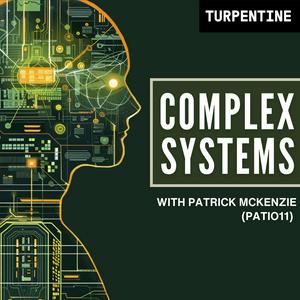
We live in a world where our civilization and daily lives depend upon institutions, infrastructure, and technological substrates that are _complicated_ but not _unknowable_. Join Patrick McKenzie (patio11) as he discusses how decisions, technology, culture, and incentives shape our finance, technology, government, and more, with the people who built (and build) those Complex Systems.
Sítio Web de podcastOuve Complex Systems with Patrick McKenzie (patio11), Boa moeda, má moeda e muitos outros podcasts de todo o mundo com a aplicação radio.pt
Obtenha a aplicação gratuita radio.pt
- Guardar rádios e podcasts favoritos
- Transmissão via Wi-Fi ou Bluetooth
- Carplay & Android Audo compatìvel
- E ainda mais funções
Obtenha a aplicação gratuita radio.pt
- Guardar rádios e podcasts favoritos
- Transmissão via Wi-Fi ou Bluetooth
- Carplay & Android Audo compatìvel
- E ainda mais funções

Complex Systems with Patrick McKenzie (patio11)
Leia o código,
descarregue a aplicação,
ouça.
descarregue a aplicação,
ouça.
 Portugal
