
Ouve este podcast gratuitamente na aplicação: Descarrega gratuitamente na App Store
radio.pt
Sleeptimer
Guardar rádio
28 episódios
Letters from Leeds
02/10/2026 | 41min* Warning: Today’s episode contains discussions of threatening communication and blackmail*
Summer, 2011, Leeds, England. Two elderly residents of a housing estate are feeling terrorised after receiving hand delivered typed letters accusing them of wrongdoing and threatening harm unless they comply with a request for large sums of cash. The letters suggest that they are being watched on a daily basis, and warn them not to involve the police. They both do contact the police, who shortly identify and arresta suspect – local woman Judy Dunne. A warrant is issued to search Dunne’s house, and a number of her writings areseized. She is also asked to produce some writings while in custody. Struggling to find enough evidence to link Dunne to the letters, police turn to newly qualified forensic linguist Dr Nicci MacLeod for help.
This episode discusses how authorship analysis helped in the case.
Have a question for Nicci or Tim? Email us at writingwrongs@aston.ac.uk and we may answer it during an upcoming episode!
Check out the official AIFL blog for more forensic linguistic goodies here: https://medium.com/@AIFLblog
If you have been affected by any of the themes in this week’s episode, please contact one of these free sources:
https://www.samaritans.org/how-we-can-help/contact-samaritan/
https://www.helpguide.org/find-help
Production Team: Jordan Robertson, Neus Alberich Buera, Karolina Placzynta, James Cresswell
Sound: James Cresswell
Editing: Angela Walker
Visual design: George Grant
Additional Voices: Amy Booth
Professor Tim Grant’s home page: Tim Grant -Aston Research Explorer
Dr Nicci MacLeod’s home page: Nicci MacLeod -Aston Research ExplorerO Scotland, Scotland #TwitterThreatTrial
04/09/2026 | 52min* Warning: Today’s episode contains discussions of threatening communication *
What makes something a threat? In today’s episode, our hosts Dr Nicci MacLeod and Professor Tim Grant are joined by Dr Isabel Picornell, who tells us about a case in which this was the central question.
May 3rd, 2021, Scotland. Three days before the Scottish Parliament election and amidst fervent jabs being traded from supporters from all sides, a certain tweet stood out. “See you Galloway, we will get you, ye understand??” Twitter (now X) user @KyleHibee07 posted. This was condemned by supporters of the intended recipient, George Galloway, running for a seat at the time, who took this as a threat on the ex-Labour MP’s life. Our hosts and guest explore the issue of identifying threatening communications by examining this tweet.
Have a question for Nicci or Tim? Email us at writingwrongs@aston.ac.uk and we mayanswer it during an upcoming episode!
Check out the official AIFL blog for more forensic linguistic goodieshere: https://medium.com/@AIFLblog
If you have been affected by any of the themes in this week’s episode, please contact one of these free sources:
https://www.samaritans.org/how-we-can-help/contact-samaritan/
https://www.helpguide.org/find-help
Production Team: Jordan Robertson, Neus Alberich Buera, Karolina Placzynta, James Cresswell
Sound: James Cresswell
Editing: Angela Walker
Visual design: George Grant
Additional Voices: Mike Clarkson, Ian MacArthur, BrynMacArthur, Louise Martin, Ali Murray, David Steele, Paula Steele
With our thanks to Dr Isabel Picornell
Artwork image credits
Artwork image of George Galloway: By David Hunt from Warwickshire, UK - Stop The War - 32 - George Galloway, CC BY 2.0, https://commons.wikimedia.org/w/index.php?curid=3002252
Artwork image of Scottish flag: Jawad Ali on Vecteezy https://www.vecteezy.com/free-png/scotland-flag-waving
Artwork of An Incident in the Rebellion of 1745, an oil on canvas, painting by David Morier is out of copyright and taken from the Wikipedia link below.
For the painting that was part of the original tweet and to find out more about the battle of Culloden see: https://en.wikipedia.org/wiki/Battle_of_Culloden#/media/File:The_Battle_of_Culloden.jpg
Professor Tim Grant’s home page: Tim Grant - Aston Research Explorer
Dr Nicci MacLeod’s home page: Nicci MacLeod - Aston Research Explorer
Dr Isabel Picornell’s webpage: Forensic Linguistics | Qedforensics
Dr Isabel Picornell’s latest book, The Linguistics of Analysing Deception in Written Texts: https://www.cambridge.org/core/elements/abs/linguistics-of-analysing-deception-in-written-texts/C257606CC51F70AAED702FBBDE7C41ECWriting Wrongs Live! 2026 Trailer.
18/08/2026 | 0minTickets here!Linguistics, Life, and Death
07/08/2026 | 1h 5min* Warning: Today’s episode contains discussions of murder and racial profiling *
Some time in the 2000s, somewhere in the USA. John Smith, an African American male defendant, has been accused of murder. While in jail awaiting trial, he makes a phone call to his cousin. It was believed John confessed to the murder. The defence disagreed, but needed linguistic assistance to help them. Elsewhere in the country, tragedy has struck. 7-year-old Leona Harris was attending a house party with her father, Robert. While standing in the front garden with some friends, they came under gunfire from a passing car. A number of the group were wounded – Leona and Robert fatally so. The police believed they had identified the gang responsible, and the individual who pulled the trigger, and brought him in to be interrogated. However, they needed more information to charge him with the murders. To obtain this, they approached a former member of the gang, Sidney Brown, to help them gather new evidence to arrest the prime suspect – Marcus Jeffreys. Sidney was provided with a mobile phone and instructed to call Marcus, the conversation being recorded and later transcribed. The prosecution’s case was that the transcript clearly showed Marcus agreeing to the proposition that he had committed the murders. Marcus’s defence disagreed.
In today’s episode, our hosts Dr Nicci MacLeod and Professor Tim Grant are joined by Professor of Linguistics John Baugh. He’s come to talk to us about his type of linguistic profiling, which occurs when someone’s speech triggers discriminatory bias against them. Through a discussion of two cases John has worked on, he explains how his expertise tackled linguistic evidence in the US criminal justice system.
For a list of our sources and more information about this case, please visit https://www.aston.ac.uk/writing-wrongs
Have a question for Nicci or Tim? Email us at writingwrongs@aston.ac.uk and we may answer it during an upcoming episode!
Check out the official AIFL blog for more forensic linguistic goodies here: https://medium.com/@AIFLblog
If you have been affected by any of the themes in this week’s episode, please contact one of these free sources:
https://www.samaritans.org/how-we-can-help/contact-samaritan/
https://www.helpguide.org/find-help
Production Team: Jordan Robertson, Neus Alberich Buera, Karolina Placzynta, James Cresswell
Sound: James Cresswell
Editing: Angela Walker
Visual design: George Grant
With our thanks to Professor John Baugh
Professor Tim Grant’s home page: Tim Grant - Aston Research Explorer
Dr Nicci MacLeod’s home page: Nicci MacLeod - Aston Research Explorer
Professor John Baugh’s home page: John Baugh | Faculty | The People of Rice | Rice University
Professor John Baugh’s book: Linguistics in Pursuit of Justice
Center for African and African American Studies at Rice University
Academic resources
Baugh, J. (2016). Linguistic profiling and discrimination. The Oxford handbook of language and society, 349-368.
Cotterill, J. (2003). Language and power in court: A linguistic analysis of the OJ Simpson trial. Springer.
Dixon, J. A., Mahoney, B., & Cocks, R. (2002). Accents of guilt? Effects of regional accent, race, and crime type on attributions of guilt. Journal of Language and Social Psychology, 21(2), 162-168.
Fraser, H. (2020). Forensic transcription: The case for transcription as a dedicated branch of linguistic science. In The Routledge handbook of forensic linguistics (pp. 416-431). Routledge.
OJ Simpson Trial Transcript http://simpson.walraven.org/jul12.html
Other resources
BBC 2016, “Renting while black,” https://www.bbc.co.uk/news/blogs-trending-35464634.
The Fair Housing Act
ResourcesThe Case of Don Juan de Marin
03/07/2026 | 38min*Warning: this episode contains descriptions of emotional abuse and manipulation*
---
November 12, 2018, Madrid, Spain. 47-year-old Galician man Rodrigo Nogueira Iglesias is arrested near the Puerta de Atocha railway station. His crimes stretched back more than twenty years. Rodrigo frequented social media platforms and dating websites where he used fake profiles, pretending to be different people with different names and professions, all with the initial goal of attracting the attention of women who could be potential victims.
We are joined by Dr Sheila Queralt – a friend of the Institute and Spain’s top forensic linguistics expert, having consulted on some 300 cases over the past 15 years and testified as a linguistics expert witness in criminal and civil trials across 10 countries, with cases reaching courts including the ECHR. Her work in forensic linguistics at ForensicLab continues through her Laboratory based in Barcelona, which provides linguisticanalysis of recorded conversations and voice messages, as well as written documents.
---
In the episode, we make references to episodes 1.4 Romance Fraud, featuring a conversation with Dr Lis Carter, and 3.2 The Multiple Personas of an Online Child Abuser, featuring DrEmily Chiang.
Have a question for Nicci or Tim? Email us at writingwrongs@aston.ac.uk and we may answer it during an upcoming episode!
Check out the official AIFL blog for more forensic linguistic goodies here:
https://medium.com/@AIFLblog
If you have been affected by any of the themes in this week’s episode, please contact one of these free sources:
https://www.samaritans.org/how-we-can-help/contact-samaritan/
https://www.helpguide.org/find-help
---
Production Team: Angela Walker, Jordan Robertson, Neus Alberich Buera, Karolina Placzynta
Sound: James Cresswell
Visual design: George Grant
Editing: Angela Walker
Additional voices: Salvador Alberich Castelló
---
Illustration by Víctor Gomollón García. Reproduced with the illustrator's kind permission. The illustration was originally created for the book Estafas amorosas by Sheila Queralt Estévez (Larousse Editorial, 2022).
More information about the book:
https://www.larousse.es/libro/libros-ilustrados-practicos/estafas-amorosas-sheila-queralt-estevez-9788419250179/
Español
Ilustración de Víctor Gomollón García. Reproducida con la amable autorización del ilustrador. La ilustración fue creada originalmente para el libro Estafas amorosas, de Sheila Queralt Estévez (Larousse Editorial, 2022).
Más información sobre el libro:
https://www.larousse.es/libro/libros-ilustrados-practicos/estafas-amorosas-sheila-queralt-estevez-9788419250179/
---
Professor Tim Grant’s home page: Tim Grant- Aston Research Explorer
Dr Nicci MacLeod’s home page: NicciMacLeod - Aston Research Explorer
Dr Sheila Queralt’s home page: SQ-Lingüistas Forenses
Decalogue for requesting a linguistics expert report by Sheila Queralt
News of the Nogueira Iglesias case in the Spanish press
A guide to spotting romance fraudsters
---
Academic sources
Carter, E.(2024). The Language of Romance crimes: Interactions of love, money, and threat. Cambridge University Press.
Chatten, A., Baxter, K., Mas, E., Pena, J., Tabachnick, G., Duncan, D., & MacKenzie, L. (2024). “I’ve Always Spoke Like This, You See”: Preterite-to-Participle Leveling in American and British Englishes. American Speech: A Quarterly of Linguistic Usage, 99(1), 3-46.
Queralt, S. (2022). Linguistic Profiling: A Spanish Case Study. Methodologies and Challenges in Forensic Linguistic Casework, 44–62.
Mais podcasts de Crimes verdadeiros





Podcasts em tendência em Crimes verdadeiros







Sobre Writing Wrongs
Every sentence tells a story, every word leaves a trace.
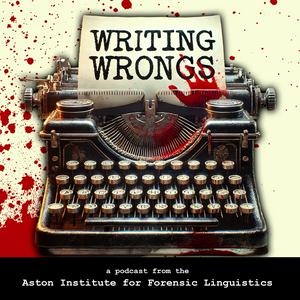
Writing Wrongs, from the Aston Institute for Forensic Linguistics, explores historic and contemporary forensic linguistic cases.
Hosts Professor Tim Grant and Dr Nicci MacLeod, who've provided expert evidence in hundreds of cases, examine a specific case and its linguistic analysis each episode.
Some episodes feature guest forensic linguists sharing their experiences as expert witnesses. The series highlights different case types, showcasing the strengths and limitations of forensic linguistics in criminal and civil investigations.
Sítio Web de podcastOuve Writing Wrongs, BETH'S DEAD e muitos outros podcasts de todo o mundo com a aplicação radio.pt
Obtenha a aplicação gratuita radio.pt
- Guardar rádios e podcasts favoritos
- Transmissão via Wi-Fi ou Bluetooth
- Carplay & Android Audo compatìvel
- E ainda mais funções
Obtenha a aplicação gratuita radio.pt
- Guardar rádios e podcasts favoritos
- Transmissão via Wi-Fi ou Bluetooth
- Carplay & Android Audo compatìvel
- E ainda mais funções

Writing Wrongs
Leia o código,
descarregue a aplicação,
ouça.
descarregue a aplicação,
ouça.
 Portugal
